


Look along the cake counter in a proper Italian cafe and you’ll see a few things that need no introduction, like tiramisu, next to a few that probably do. A glossy little cake sitting in a pool of syrup. A pastry tube stuffed with ricotta. A golden tart dotted with pine nuts.
Italian desserts are less about elaborate presentation and more about a handful of good ingredients done well: mascarpone, ricotta, espresso, citrus, custard, nuts. Most of them come from a particular town or region, and many have a story attached.
Here’s a plain-English guide to the classics, what’s in them and where they come from, and how to order them in Edinburgh.
Tiramisu
Tiramisu is the best-known Italian dessert in Britain, and for good reason. It’s layers of sponge fingers soaked in espresso, sometimes with a splash of liqueur, sandwiched with a cream made from mascarpone, eggs and sugar, then dusted with cocoa.
Where does tiramisu come from?
Most accounts place its origin in the Veneto region of north-east Italy, with the town of Treviso usually credited, in the second half of the 20th century. The name comes from the Venetian phrase for “pick me up”, a nod to the coffee and sugar.
Several towns and families have claimed to have invented it, and the argument is still going. What everyone agrees on is that it’s a relatively modern dessert, much younger than its reputation suggests.
What makes a good tiramisu?
A good tiramisu is soft but holds its shape when cut. The sponge should be soaked through, not soggy, and the mascarpone cream should be light rather than heavy. Too much sugar flattens the coffee.
At Taste of Italy, the tiramisu is homemade (£5.90), with coffee and liqueur-soaked sponge, a light mascarpone cream and chocolate. Prices are from the current dessert and drinks menu and may change.
Cannoli
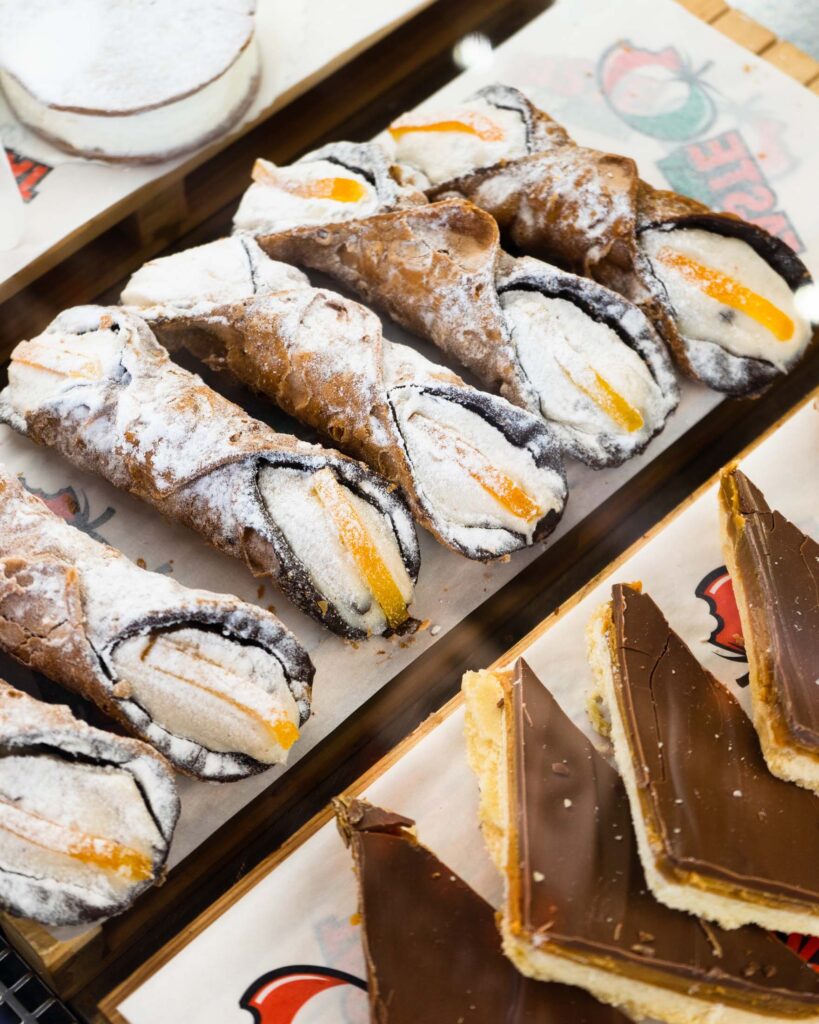
Cannoli (singular: cannolo) are Sicily’s famous pastry. A crisp, fried pastry shell, often made with a dough flavoured with Marsala, is rolled into a tube and filled with sweetened ricotta, traditionally sheep’s milk ricotta in Sicily, often finished with chocolate chips, candied fruit or chopped pistachios at each end.
Where do cannoli come from?
Cannoli are traditionally linked to Palermo and the surrounding area, and were once made mainly for Carnival, the festival season before Lent. Today they’re eaten all year round across Italy and well beyond.
How to eat cannoli
Cannoli are best filled fresh, with the ricotta piped into the shell just before serving so the pastry stays crunchy. A cannolo that’s been filled hours in advance goes soft. Eat it with your hands, ideally with an espresso.
At Taste of Italy, the cannolo siciliano (£5) is a crisp pastry roll filled with sweetened ricotta, dipped in chocolate pieces and finished with candied fruit. If you can’t decide, mini cannoli (£2 each) come in lemon, chocolate, vanilla and pistachio, so you can try a few.
Rum baba
Rum baba (babà al rum in Italian) is a small, light yeasted cake soaked in a rum syrup until it’s almost dripping. It’s often glazed, sometimes served with cream, and is one of the signature pastries of Naples.
Where does rum baba come from?
The babà has a well-travelled history. Most food historians trace it back to a yeasted cake from central Europe, which was taken up in France and soaked in alcohol, then became a favourite in Naples, where it’s now part of the city’s identity. You’ll see it in Neapolitan pastry shops alongside sfogliatelle.
What does rum baba taste like?
Light, spongy and boozy, with a sweet, sticky glaze. It’s not heavy, even though it looks rich, because the cake itself is mostly air.
The Taste of Italy rum baba (£5.50) is a fluffy glazed sponge soaked in a rum-based liqueur and dressed in apricot syrup.
Torta della nonna
Torta della nonna means “grandmother’s cake”. It’s a shortcrust pastry tart filled with a lemon and vanilla custard, topped with another thin layer of pastry and a scattering of pine nuts, then dusted with icing sugar.
Where does torta della nonna come from?
It’s most closely linked to Tuscany, and despite the name, most accounts suggest it’s a 20th-century recipe rather than an ancient family one. It’s now found across Italy in cafes and bakeries, often with an afternoon coffee.
The Taste of Italy torta della nonna (£5.40) is made with sweet shortcrust pastry, a lemon and vanilla scented custard, a thin pastry layer and pine nuts.
Affogato
Affogato means “drowned”. It’s the simplest Italian dessert there is: a scoop of gelato with a shot of hot espresso poured over it at the table. The hot and cold, bitter and sweet all happen at once.
It’s ideal if you can’t decide between dessert and coffee. At Taste of Italy, the affogato (£6.40) is made with rich crema gelato and Italian Aroma espresso.
Gelato
Gelato is Italy’s style of ice cream: denser, softer and lower in fat than most British ice cream, and served slightly warmer so the flavour comes through. There’s a full explanation in our guide to gelato vs ice cream.
At Taste of Italy, gelato is £3 for one scoop, £5 for two or £7 for three, with Madagascan vanilla, vegan strawberry, hazelnut and chocolate and a flavour of the week. There are also sundaes at £7.40, including the Golden Sunset, which comes with Scottish tablet.
Other Italian desserts worth knowing
You won’t find every Italian dessert in every cafe, but these come up often enough to be worth knowing:
- Panna cotta: “cooked cream”, set with gelatine and usually served with a fruit sauce. Associated with Piedmont in the north.
- Zabaglione: a warm, whipped custard of egg yolks, sugar and Marsala wine.
- Sfogliatella: a shell-shaped Neapolitan pastry with crisp layers and a ricotta filling.
- Panettone: the tall, domed sweet bread with candied fruit that appears every Christmas. Linked to Milan.
- Cantuccini: twice-baked almond biscuits from Tuscany, traditionally dipped in Vin Santo, a sweet dessert wine.
- Maritozzo: a soft, sweet brioche bun split and filled with whipped cream, associated with Rome.
- Gianduja: a smooth chocolate and hazelnut paste from Piedmont, used in all sorts of Italian sweets.
Italian desserts through the year
Many Italian desserts are tied to a particular time of year, even if they’re now eaten all year round.
- Christmas: panettone in the north, and pandoro, a tall, star-shaped sweet bread dusted with icing sugar, from Verona.
- Carnival: cannoli in Sicily, and fried dough treats such as chiacchiere across the country.
- Easter: colomba, a dove-shaped sweet bread similar to panettone, and pastiera, a Neapolitan tart made with ricotta and wheat.
- Summer: gelato and granita, the crushed-ice dessert from Sicily.
In Edinburgh, the seasons are less strict. A cannolo works just as well in a dark November as it does at Carnival time.
How to choose an Italian dessert
If you’re not sure what to order, a few simple rules help:
- After a heavy meal: go light. An affogato, a single scoop of gelato or a couple of mini cannoli.
- With coffee in the afternoon: a slice of torta della nonna or a cannolo, in the way an Italian might mid-afternoon.
- For a proper treat: tiramisu or a sundae.
- If you like a drink: the rum baba.
- If you’re sharing: order two or three different things and split them.
Where to try Italian desserts in Edinburgh
Taste of Italy is an all-day Italian cafe at 9 Baxter’s Place, at the top of Leith Walk, part of the Crolla family’s Vittoria Group. It opens at 8am and runs early till late, so you can stop for coffee and cake at any time of day without booking.
It’s two minutes from the Edinburgh Playhouse, so dessert after a show is easy. Our guide to restaurants near the Edinburgh Playhouse covers eating before and after a performance.
A few pairings worth trying:
- Tiramisu with an espresso: coffee with coffee, the way it should be.
- Cannolo with a macchiato: sweet ricotta and a short, strong coffee. Read our guide to Italian coffee, from macchiato to affogato if you’re not sure what to order.
- Rum baba with a Negroni Sbagliato: for an evening with no plans.
Please let staff know about any allergies. The kitchen uses nuts, flour and dairy, and can’t guarantee dishes are completely free from traces of gluten, lactose or nuts.
Frequently asked questions
What is the most popular Italian dessert?
Tiramisu is probably the best-known Italian dessert in the UK, alongside gelato, panna cotta and cannoli.
What is the difference between a cannolo and cannoli?
Cannolo is the singular and cannoli is the plural. One pastry is a cannolo; two or more are cannoli.
What is rum baba made of?
Rum baba is a light, yeasted sponge cake soaked in a rum syrup. It’s usually glazed and sometimes served with cream.
What does torta della nonna mean?
It means “grandmother’s cake”. It’s a Tuscan-style custard tart with a pastry lid and pine nuts on top.
Is tiramisu made with alcohol?
Many recipes include a splash of liqueur or Marsala with the coffee, though alcohol-free versions exist. It’s a no-bake dessert, so it’s assembled and chilled rather than cooked. Ask staff if you need to avoid alcohol.
Where can I get Italian desserts in Edinburgh?
Taste of Italy, at the top of Leith Walk near the Edinburgh Playhouse, serves homemade tiramisu, plus cannoli, rum baba, torta della nonna, affogato and gelato, every day.
Save room for dessert
The best way to learn Italian desserts is to try them. Have a look at the dessert and drinks menu, then walk in at Baxter’s Place and order something you haven’t had before.