


Order a latte in Milan and there’s a fair chance you’ll be handed a glass of milk. Order a cappuccino after lunch and you might get a look from the barista. Italian coffee has its own names, its own habits and its own unwritten rules, and most of the drinks on a British coffee menu started life in Italy with a slightly different meaning.
This guide explains the main Italian coffees in plain English: what’s in each one, how they differ, and how to order them, starting with the one people ask about most.
What is a macchiato?
A macchiato is a shot of espresso “marked” with a small amount of milk, usually a spoonful of foam. Macchiato means “stained” or “marked” in Italian. The milk softens the edge of the espresso without turning it into a milky drink.
It’s served in a small cup and is gone in a few sips. If you like the flavour of espresso but find it a bit too sharp on its own, a macchiato is the drink for you.
Macchiato vs latte macchiato
These are two different drinks with confusingly similar names:
- Caffè macchiato: mostly espresso, with a touch of milk.
- Latte macchiato: mostly steamed milk, “marked” with a shot of espresso poured in on top. It’s often served in a tall glass so you can see the layers.
Some chain coffee shops use “macchiato” for large, sweet, milky drinks, such as a caramel macchiato, which is closer to a latte macchiato. In an Italian cafe, a macchiato means the small, strong version.
At Taste of Italy, a macchiato is £2.70 with one shot or £3.30 with two. Prices are from the current dessert and drinks menu and may change.
Espresso: where everything starts
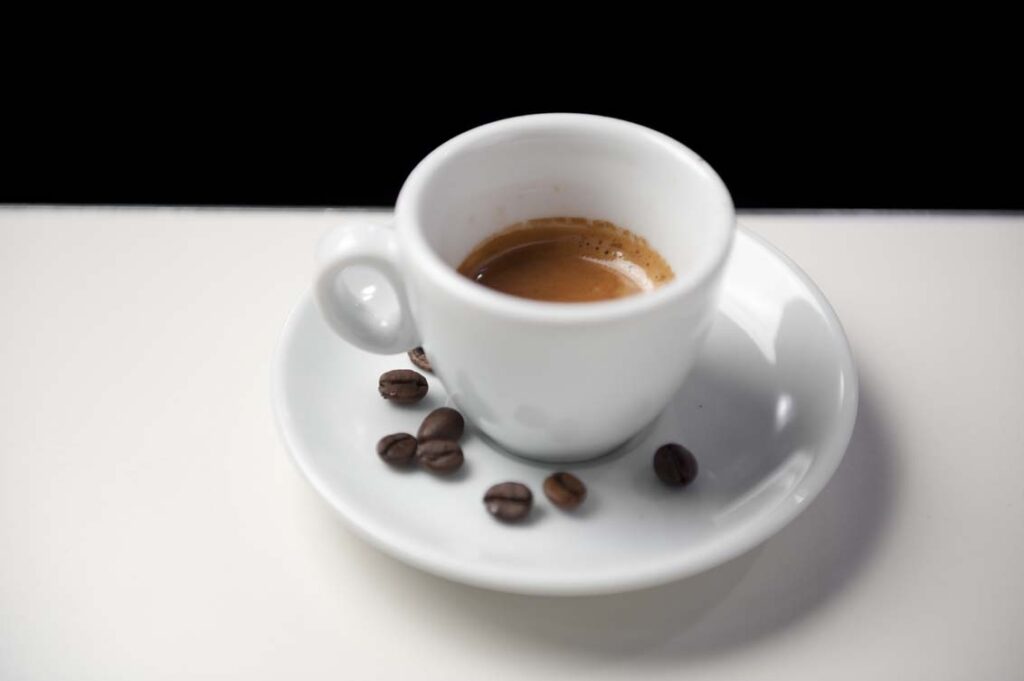
Almost every Italian coffee is built on espresso: a small, concentrated shot made by forcing hot water through finely ground coffee under pressure. A good espresso has a layer of golden-brown foam on top, called the crema, and a rich, rounded flavour rather than a burnt one.
In Italy, if you ask for “un caffè”, you’ll get an espresso. It’s the default.
- Espresso: a single shot. £2.60 at Taste of Italy.
- Double espresso (doppio): two shots. £3.20.
- Ristretto: a “restricted” shot, made with the same amount of coffee but roughly half the water, for a shorter, more intense drink.
- Lungo: a “long” shot, with more water run through the coffee for a milder, larger espresso.
The coffee at Taste of Italy is Italian Aroma espresso.
Cappuccino
A cappuccino is an espresso topped with steamed milk and a thick layer of milk foam, usually in roughly equal parts. It’s lighter and foamier than a latte, and often finished with a dusting of cocoa.
The name is usually linked to the colour of the habits worn by Capuchin friars.
The cappuccino rule
In Italy, cappuccino is traditionally a breakfast drink, and many Italians wouldn’t order one after late morning, and certainly not after a meal. The thinking is that a big, milky coffee doesn’t sit well on a full stomach.
Nobody in Edinburgh will stop you ordering one at 3pm. A cappuccino at Taste of Italy is £3.90, made with two shots.
Latte
In Italian, latte simply means milk. What British coffee shops call a latte is a caffè latte: espresso with plenty of steamed milk and a thin layer of foam. It’s milder and creamier than a cappuccino.
At Taste of Italy, a latte is £3.90 with two shots. Soya, oat, almond and coconut milk are available for 80p extra, and you can add a syrup, such as vanilla, caramel or hazelnut, for £1.
Americano
An americano is an espresso topped up with hot water after it’s made, unlike a lungo, where the extra water runs through the coffee. That gives a longer, lighter drink closer in strength to filter coffee. The usual story is that it was named after American soldiers in Italy who diluted espresso to make it more like the coffee they were used to at home.
It’s £3 for a single shot or £3.40 with two at Taste of Italy.
Mocha
A mocha is a latte with chocolate added: espresso, chocolate and steamed milk, sometimes topped with cream. It’s a good middle ground between a coffee and a hot chocolate. A mocha is £4.20 at Taste of Italy, and you can add cream and marshmallows for £1.40.
Affogato
Affogato means “drowned”, and it’s half coffee, half dessert: a scoop of gelato with a hot shot of espresso poured over it. The gelato melts into the coffee and the two become something better than either.
At Taste of Italy, the affogato is £6.40, made with rich crema gelato. If you’re curious about gelato itself, our guide to gelato vs ice cream explains what makes it different.
Cold coffee
Italian coffee isn’t only hot. On warmer days:
- Iced coffee frappé: ice-cold espresso, milk and ice, topped with cream. £5.20 at Taste of Italy.
- Caffè shakerato: an Italian summer favourite, made by shaking espresso with ice and a little sugar and serving it in a chilled glass.
- Espresso Martini: not strictly a coffee, but espresso shaken with vodka and coffee liqueur. £9.50, available in different flavours.
How to order coffee like an Italian
A few habits from Italian coffee culture:
- Stand at the bar. In Italy, many people drink their espresso standing at the counter in a couple of minutes. In many Italian cafes, standing at the bar (al banco) is cheaper than sitting at a table (al tavolo).
- Keep it small. Italian coffees are generally smaller and more concentrated than British ones.
- Milk in the morning, espresso after. Cappuccino with breakfast, espresso or macchiato after lunch and dinner.
- Pair it with something sweet. A pastry in the morning, a small cake in the afternoon.
None of this is compulsory in Edinburgh, but it’s a good way to taste the coffee properly. At home, many Italians make their coffee in a moka pot on the hob rather than with an espresso machine.
Is Italian coffee stronger?
Italian coffee often tastes stronger because it’s served smaller and with less milk, not because there’s necessarily more caffeine in the cup. A single espresso is a small, concentrated drink, while a large filter coffee can contain as much caffeine or more, spread through a bigger volume of water.
What changes is the intensity of the flavour. Espresso is thicker and richer, with that layer of crema on top, and it’s meant to be drunk quickly while it’s hot.
What to order if you’re new to Italian coffee
If you usually drink a large milky coffee, try working your way down:
- Latte: familiar, mild and creamy.
- Cappuccino: a little stronger, with more foam and less milk.
- Macchiato: mostly espresso, with just a touch of milk.
- Espresso: the real thing, best with a little sugar if you find it sharp.
Or go sideways and order an affogato. It’s the friendliest introduction to espresso there is.
Coffee and something sweet
Italian coffee comes into its own next to a small cake. A few pairings to try at Taste of Italy:
- Espresso and homemade tiramisu (£5.90).
- Macchiato and a cannolo siciliano (£5).
- Cappuccino and a muffin (£3) in the morning.
- Americano and a slice of torta della nonna (£5.40) in the afternoon.
Our guide to Italian desserts explains what each of these cakes is and where it comes from.
Where to get Italian coffee in Edinburgh
Taste of Italy is an all-day Italian cafe at 9 Baxter’s Place, at the top of Leith Walk, part of the Crolla family’s Vittoria Group. It opens at 8am every day, and you can sit in or take your coffee away.
It’s a short walk from Edinburgh Bus Station, St James Quarter and Waverley, and two minutes from the Edinburgh Playhouse, so it’s an easy stop on the way to work, the train or a show. If you’re coming in for breakfast as well, our guide to the best breakfast in Edinburgh has more.
Frequently asked questions
What is a macchiato?
A macchiato is a shot of espresso with a small amount of milk foam on top. The name means “stained” or “marked” in Italian.
What is the difference between a macchiato and a cappuccino?
A macchiato is mostly espresso with a spoonful of milk foam. A cappuccino has much more milk: espresso topped with steamed milk and a thick layer of foam.
What is the difference between a latte and a cappuccino?
A latte has more steamed milk and a thin layer of foam, so it’s milder and creamier. A cappuccino has less milk and more foam.
What does “un caffè” mean in Italy?
In Italy, asking for “un caffè” gets you an espresso.
What is an affogato?
An affogato is a scoop of gelato with a shot of hot espresso poured over it. The name means “drowned”.
Is Italian coffee stronger than British coffee?
It usually tastes stronger because it’s served smaller and with less milk. A single espresso doesn’t necessarily contain more caffeine than a large filter coffee, but the flavour is more concentrated.
Can I get plant-based milk?
Yes. At Taste of Italy, soya, oat, almond and coconut milk are available in hot drinks for 80p extra.
Find your coffee
If you’ve only ever ordered a latte, try a macchiato next time, or an affogato after lunch. Have a look at the dessert and drinks menu and drop in at Baxter’s Place any time from 8am.